Numerical Methods · interactive worked example
Heat Transfer Through Concentric Cylinders
A pipe carries heat outward through its wall. Given the heat flow and the inner radius, how thick does the wall need to be? The equation that answers this has the radius buried inside a logarithm inside a logarithm — no algebra gets you out. Five root-finding methods walk in from different directions and land on the same answer.
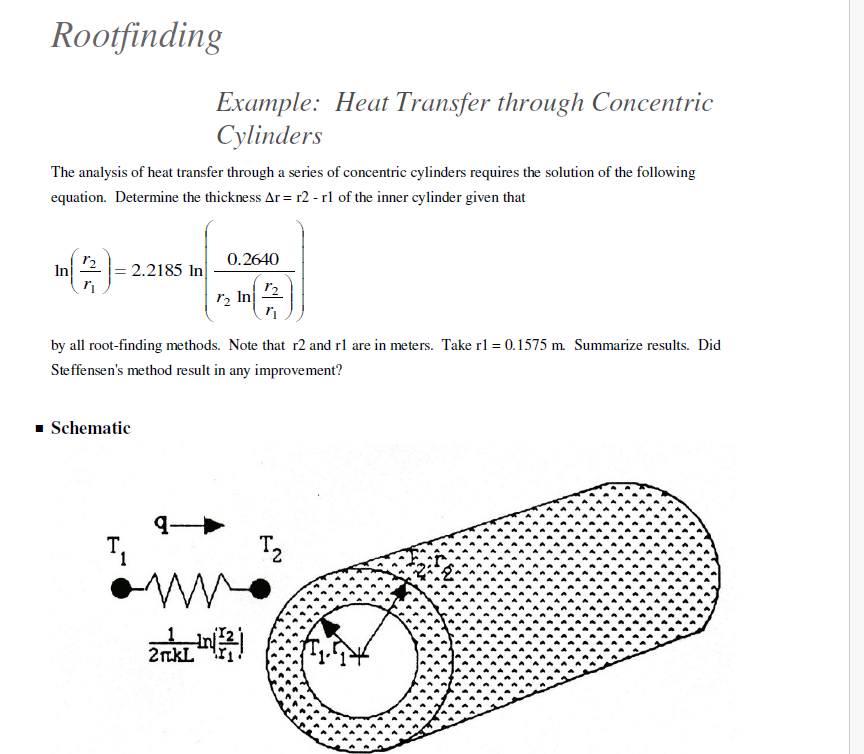
A root-finding example from the site author's own engineering lecture notes. Original problem schematic:
Convergence: |f(r₂)| per iteration (log scale) — lower is closer to the root
Cross-section
What you're seeing
—
Method
Tolerance
Iteration history
Why this equation has no closed form
The governing equation for steady radial conduction through a cylindrical wall, with a convective boundary on the outside, gives ln(r₂/r₁) = 2.2185·ln(0.264/(r₂·ln(r₂/r₁))) once the known quantities (heat flow, conductivity, convection coefficient) are folded into those two constants. The unknown r₂ appears three times, once buried inside the innermost log — there's no algebraic move that isolates it. This is the same situation as the Root Finding lab's classic example, just dressed up in real engineering units instead of an abstract polynomial.
The same equation, five different walks to the same root
Bisection brackets the root and halves the interval — slow but unconditionally safe. Newton's method uses the local slope (numerically estimated here) to leap toward the root — fast, but needs a derivative. Secant approximates that slope from two nearby points instead of computing it — almost as fast, no derivative needed. Fixed-point iteration rearranges the equation into r₂ = g(r₂) and just repeats it — simple, but only if the rearrangement happens to converge (try rearranging the equation a different way and it can diverge immediately, as the original notebook this is based on found).
Steffensen's method: the fixed-point speedup
The convergent rearrangement here is real but slow — plain fixed-point iteration takes 88 steps to reach a tolerance of 0.001. Steffensen's method takes the same iteration g(r₂) and applies Aitken's Δ² acceleration to it: compute two ordinary steps, then extrapolate past both using how far apart they are. The same convergent g, accelerated this way, reaches the same tolerance in 3 steps — turning a borderline-impractical method into one of the fastest options here, without ever needing a derivative. That's the direct answer to "did Steffensen's method help?"
EngineeringCandy · Five root-finding methods on one real transcendental equation